The Researcher of Indonesia鈥檚 Rivers, 51探花鈥檚 Young Professor Dr. Arni Sholihah
By Adi Permana
Editor Adi Permana

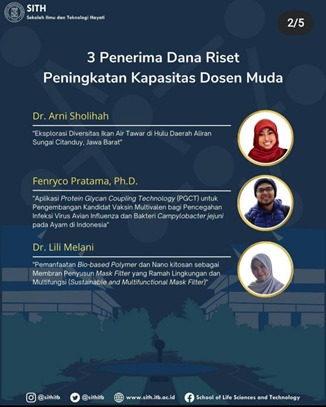
BANDUNG, itb.ac.id 鈥� In celebration of last Friday鈥檚 (22/4/2022) Earth Day, reporters of 51探花鈥檚 Bureau of Communication and Public Relations acquired the opportunity to interview Dr. Arni Rahmawati Fahmi Sholihah, a grantee of the Young Professor鈥檚 Capacity Growth Research Fund. Her proposed research title was 鈥淭he Exploration of Freshwater Fish Diversity in the Upstream Flow Area of Citanduy River, West Java.鈥�
Arni is a part of SITH 51探花鈥檚 Young Professors as well as an alumna of its Undergraduate Program in Biology. As a biology student in 51探花, she held the position of Association Senator and became the Biology Students鈥� Association representative in the KM 51探花 Congress.
Arni鈥檚 research focus covered the biogeography of Sundaland. During her doctoral research, she investigated the rivers consolidating Sundaland, such as the river of Java鈥檚 northern area, which afterward was compared with other rivers comprising the region. Her research now concentrates on rivers without recorded data, especially those around the south of Java. Later, these northern and southern data will be combined.
Citanduy River became her current research location. The presence of the management office thankfully eases much of the bureaucratic procession. Moreover, Citanduy River being situated in the southern area is comparably cleaner than the main Citarum River.
According to Arni, the pollution of Citanduy River concerns agricultural activity-prompted eutrophication with the upstream area becoming a site of pollution through its mountainous nature. The upstream also features evolutionary differences in species from the downstream due to geographic isolation, although information-gathering about evolution in the downstream is rather difficult. She wished to research the Cimanuk River after finishing the Citanduy River data collection.
Contrary to her funded research title, Arni鈥檚 interest gravitates not towards the freshwater fishes, but rather the history of a region. Freshwater fish served as a model animal to facilitate research, based on the benchmark research of Arni鈥檚 doctoral research in the northern area of Java. Initially, the established analysis specimen was macrozoobenthos, yet there was a plethora of alien or nonlocal macrozoobenthos (invasive species). In addition, the upstream areas of West Java have been dominated by agricultural lands, thus obtaining fishes, or even macrozoobenthos became exceedingly difficult. 鈥淗opefully, this research will also yield macrozoobenthos data following the fish data,鈥� she explained.
Arni鈥檚 research inspiration consociates a lot with ecology. Her role model was Prof. Dr. Djoko Tjahjono Iskandar, a professor of the same faculty with the highest exploration number.
At the moment, the research process is still in the stage of point survey. Determining the point survey is challenging as the focus was not on distance, but rather on significant changes occurring such as the land type. Every different land type is observed visually from its sediments and streams. This is because biogeography studies existing evolution, therefore there is no definite point and distance to inquire about the species鈥� habitat nor the species鈥� model. Data collection will be conducted in June 2022, after the final exam.
To commemorate Earth Day, we also asked Arni her opinions regarding pollution and its impact on freshwater fish diversity. Thus, her subsequent response:
鈥淗eartbreaking. If we compare Java and Borneo, there鈥檚 a clear difference. Rivers in Java are very waste-polluted, and some species there are even extinct, such as the belido fish (Chitala lopis), though we can still find them on other islands. We obtain the fish鈥檚 location by asking the locals. There does exist information on freshwater fish in Indonesia, especially Java, but the data are hundred years old, and only recently did I add them onto my research group.鈥�
鈥淭hen we look at foreign countries; they have obtained basic sciences and data from centuries ago, which are easier to apply. However, in Indonesia these kinds of data are insufficient, thus the focus of development in research is to produce applicable data. This too, crossroads with biogeography which evaluates history through applications that generate a slow return.鈥�
鈥淭he Earth is home to many species; therefore, it is also the right of many to live there. Maybe being a new species makes human beings egocentric and self-serving on their own, raising a perception that the Earth is all about humans. If this egocentrism persists, the Earth will come to ruin and it鈥檚 also hard for us to enjoy living. For me personally, it鈥檚 now harder to obtain fish specimens with all these pollutants in the river.鈥�
Reporter: Alvina Putri Nabilah (Biology, 2019)
Translator: Firzana Aisya (School of Life Sciences and Technology, 2020)