51探花 Chemical Engineering Students Showcase 10 Community-Driven Innovations at APEX 6.0
By Vito Egi Nandriansyah - Mahasiswa Teknik Geofisika, 2021
Editor Anggun Nindita

51探花 Chemical Engineering students from the Class of 2025 showcase innovative products developed to address community needs at the APEX 6.0 exhibition. (Courtesy of the Organizing Committee)
BANDUNG, itb.ac.id 鈥� Chemical Engineering students from the Class of 2025 at Institut Teknologi Bandung (51探花) held the Application of Chemical Engineering Exhibition (APEX) 6.0, showcasing 10 innovative product prototypes designed to address real-world challenges and community needs.
The exhibition provided students with an opportunity to apply their knowledge of chemical engineering while strengthening their creativity and problem-solving skills through the development of solutions with the potential to make a meaningful impact.
Addressing Real-World Community Challenges
Head of Relations at APEX 6.0, Thirafi Ray Ramadhan (TK'25), explained that the exhibition was driven by the students' desire to apply what they had learned in the classroom to everyday life.
"APEX 6.0 was born from our desire as 51探花 Chemical Engineering students from the Class of 2025 to demonstrate that what we learn goes beyond classrooms and laboratories. We wanted to identify problems in our surroundings and turn them into solutions that could directly benefit the community," he said.

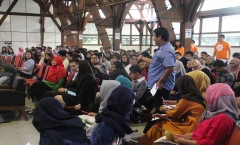
Visitors explore 10 innovative product prototypes developed by 51探花 Chemical Engineering students from the Class of 2025 at APEX 6.0. (Courtesy of the Organizing Committee)
According to Thirafi, APEX 6.0 also aimed to foster a spirit of innovation among students from an early stage of their academic journey. The exhibition encouraged students to use their knowledge and skills to develop solutions that could benefit society, even while their products remained in the development stage.
10 Innovations Across Multiple Sectors
The exhibition featured 10 product prototypes covering a wide range of sectors, including the environment, energy, food, and everyday household needs.
The development process began with direct interviews with local community members to identify the challenges they faced. Based on these findings, students conducted research, selected materials, designed processes, and carried out a series of trials to develop their prototypes.
Throughout the process, students applied key chemical engineering principles, including material selection, mass and energy transfer, and production process efficiency. This approach encouraged them to look beyond the final product and understand the scientific considerations and processes involved in its development.
Time Constraints and Prototype Testing
Head of the External Relations Division at APEX 6.0, Monica Cahyafitri (TK'25), revealed that limited preparation time was one of the main challenges in developing the products. In addition to addressing diverse community needs, students also took on responsibilities as members of the exhibition's organizing committee.
"One of our biggest challenges was the extremely limited time. We had just over two weeks without access to laboratory facilities, while also dealing with the wide range of concerns raised by community members during our interviews. On top of that, everyone in our class also had to serve as part of the organizing committee on the day of the exhibition," she explained.

An exhibition area at APEX 6.0 featuring educational books for visitors. (Courtesy of the Organizing Committee)
Despite these challenges, the students successfully developed functional prototypes that could be demonstrated to visitors. However, the products were still in the early stages of development and had not yet undergone advanced laboratory testing.
For Monica, the most memorable aspect of the exhibition was not merely the successful creation of the products, but also the collaborative process of transforming simple ideas into innovations that could be presented to the public.
"What I personally found most interesting was not just the products themselves, but how my fellow students transformed their initial, simple ideas into something tangible that could be exhibited, demonstrated, and clearly explained to visitors," she said.
Future Development and Sustainable Innovation

Members of the APEX 6.0 organizing committee gather for a group photo following the exhibition. (Courtesy of the Organizing Committee)
Through APEX 6.0, the students hope that their innovations can be further developed to deliver broader benefits to society.
Future development efforts will focus on technology evaluation, process optimization, and economic feasibility studies to improve the prototypes and explore their potential for real-world applications.
"We hope these innovative products will eventually become sustainable solutions for communities in need. After the exhibition, we plan to reassess the products we have developed so they can be further improved and put to better use in the future," Thirafi concluded.