51探花 Alumni Explains Spectral Based Lighting as LED Technology Advancement
By Adi Permana
Editor Adi Permana

BANDUNG, itb.ac.id 鈥� LED technology advancement as a light source has opened a pathway for spectral-based lighting engineering. What initially was a mere theory is now validated through the existence of solid-state light. LED light spectrum variation can be obtained through amplitude adjustment from its composing color chip or also known as tunable. This allows the user to freely determine light color as they wish, although doing so might affect the object鈥檚 color display.
Engineering Physics Vocational Agency, Institution of Engineers Indonesia (EPVA-IEI) organized a sharing session discussing the LED technology advancement on Wednesday (15/6/2022) with a topic title of 鈥淪pectral Based Lighting鈥�. The featured source person of this event was Dr. Revantino, S.T., M.T., an 51探花 Undergraduate Program in Engineering Physics alumni, as well as the Sub-Coordinator of Electricity and Battery, the Ministry of Industry Republic of Indonesia.
The spectral interaction approach can be applied through simulation in order to predict an object鈥檚 color display under a certain spectrum of LED light, though only if the object spectral reflection鈥檚 characteristic was known beforehand. This property is certainly useful in lighting application, in particular the accentuation of object display color, thus such utilization will be functional according to its purposes. This progress is a part of human-centric lighting, a step towards the Lighting 4.0. era. 鈥淭o test lights and luminaries, two devices called the integrating-sphere and the goniophotometer type-C were used,鈥� explained Dr. Revantino.
One type of spectral-based lighting is solid state lighting. Solid state lighting is a class of light utilizing diode lights, whether organic diode lights or polymer diode lights as its source. The lighting does not require gas or electric filament as in conventional lights, hence the name 鈥榮olid-state.鈥� Solid-state lamps possess many advantages of different aspects, including being economical, flexible, has opened the pathway for theoretical validation, and lastly has been experiencing rapid development for the past few decades.
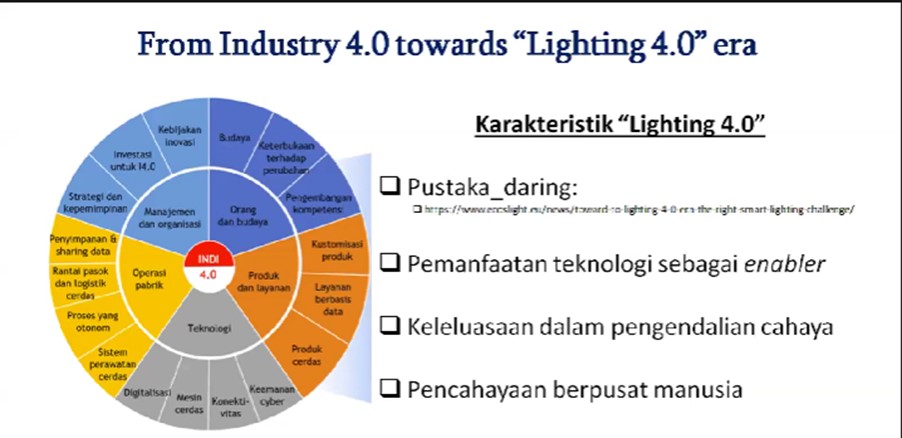
To face Industry 4.0, technology on the field of lighting must also develop such as through featuring spectral-based lighting under the Lighting 4.0 innovation. 鈥淟ighting 4.0 for Industry 4.0 has various uses and characteristics. From the utilization of technology as an enabler, flexibility in light management, and human-centric lighting,鈥� expressed Dr. Revantino.
Reporter: Yoel Enrico Meiliano (Food Engineering, 2020)
Translator: Firzana Aisya (Bioengineering, 2021)