Downstreaming Natural Resources to Overcome Indonesia's Unstable Economy
By Asep Kurnia, S. Kom
Editor Asep Kurnia, S. Kom

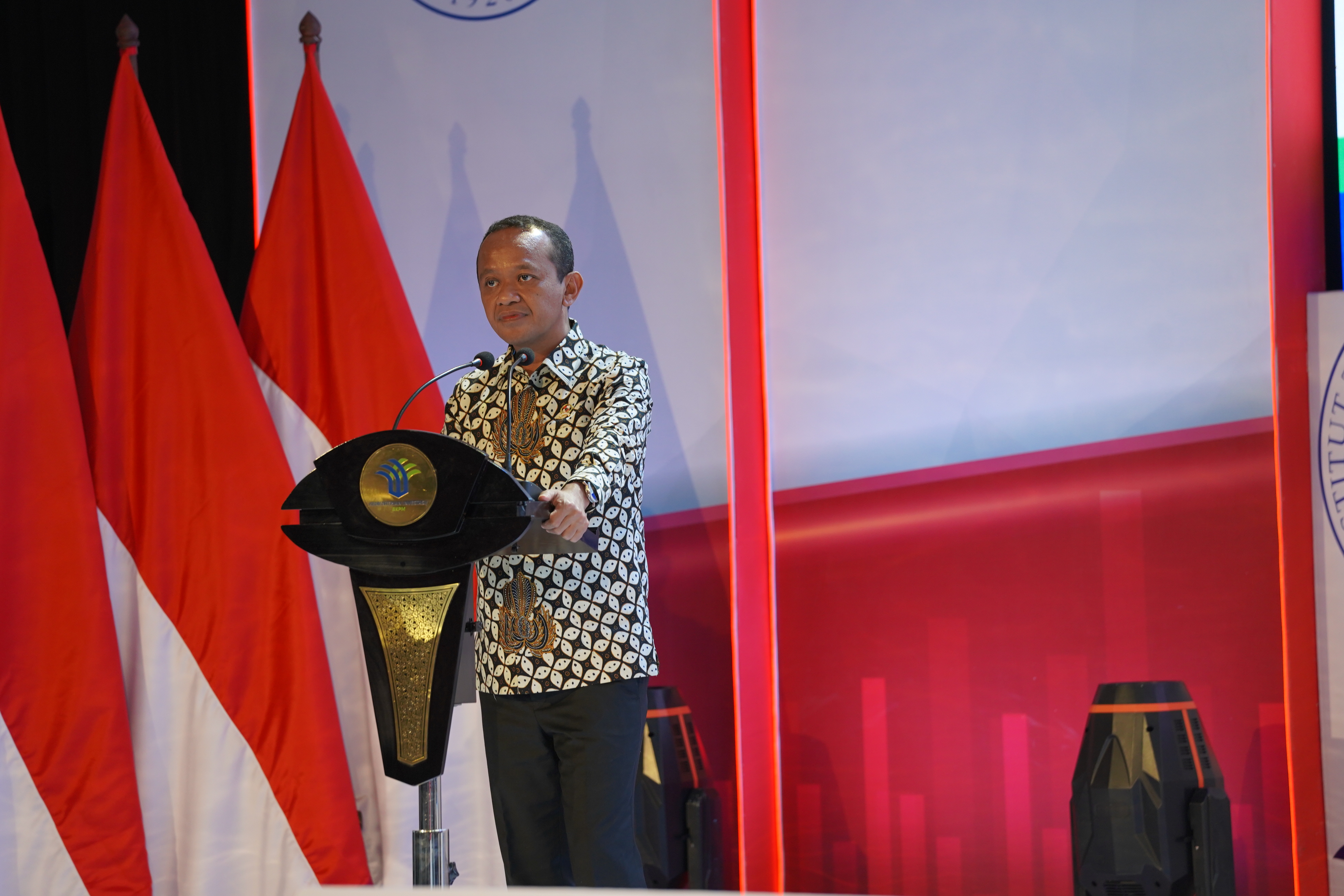
BANDUNG, itb.ac.id鈥擭owadays, The global economy is plagued by uncertainty, and investment is the key to its recovery. To raise the nation's economy, the government of Indonesia is currently promoting the down-streaming of natural resources, as delivered in this week鈥檚 guest lecture titled "Transformation of the Economy through Local Downstreaming" on Wednesday (5/10/2022).
The class was held at the West Hall of the 51探花 campus and was also live streamed via 51探花's Youtube Channel. For this week's guest lecture, 51探花 has invited Richard C. Adkerson (Chief Executive Officer of Freeport-McMoran) and Bahlil Lahadalia (Head of the Investment Coordinating Board) as the speakers. Both of the speakers are currently visiting seven state universities in Indonesia to share their scientific orations, with this class marking 51探花 as their 4th campus visitation.
Bahlil stated that various global dynamics could suddenly threaten Indonesia鈥檚 economy. To prepare for the future, investment is crucial on the road to economic recovery. Since 2020, Bahlil has halted the export of raw goods; this decision is known as the down-streaming of natural resources, and it is useful in adding value to existing goods.
Concrete steps to stop exports of raw goods like nickels, tins, and coppers were diverted to utilization procedures, such as providing batteries for electric vehicles. This has a positive impact where exports of products derived from nickel have increased from US$ 3.3 billion (2017) to US$ 20.9 billion (2021).

Regarding the industrial downstream policy promoted by the current administration of President Joko Widodo, Richard said that Freeport Indonesia is committed to supporting the policy by establishing a single-line smelter at JIIPE (Java Integrated Industrial and Port Estate), Gresik. Its construction is already in motion, with 40% of it planned to be operational in 2024.
For now, 51.2% of Freeport Indonesia鈥檚 shares are owned by the Indonesian government while the rest are kept by Freeport McMoran. They are also in the middle of creating long-term investments. The amount of their future investment in 2021-2041 is US$ 18.6 billion with an estimated benefit of US$ 80 billion.
Freeport Indonesia鈥檚 future social investment (2021-2041) amounts to 100 million US dollars. With the investment, the reclamation of mangrove forests (10 000 Ha) on new land results in tailing deposition and watershed rehabilitation in Jayapura, covering an area of 4 232 Ha. Freeport Indonesia is also committed to reducing greenhouse gas emissions by 2030 by 30%, of which the current reduction is 22%.
Efforts in down-streaming have their challenges. Thus, industrial collaboration with business proponents in Indonesia is essential so that the targets of these efforts can be evenly distributed to create an Indonesia-centric environment. Better processing of the national natural resources can be achieved and more products with higher selling value can be made.
Reporter: Pravito Septadenova Dwi Ananta (Geological Engineering, 2019)
Translator: Ruth Nathania (Environmental Engineering, 2019)