Local Bio-Repellents for Malaria Prevention: 51探花 Strengthens Community Empowerment in Pangkajene and Kepulauan
By -
Editor M. Naufal Hafizh, S.S.

PANGKAJENE AND KEPULAUAN, itb.ac.id 鈥� Institut Teknologi Bandung (51探花) is strengthening community-based malaria prevention efforts through education on vector-borne disease prevention and the exploration of locally available natural materials as bio-repellents. This initiative was carried out under the 2026 Bottom-Up Community Service Program, organized by 51探花鈥檚 Directorate of Community Service and Expertise Services, with the theme 鈥淪trengthening Community-Based Malaria Prevention through the Exploration of Local Bio-Repellents and Optimization of Simple Extraction Technologies.鈥�
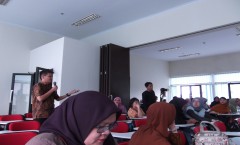
The activity took place on Saturday, September 19, 2026, at the Liukang Tupabbiring Community Health Center Hall in Mattiro Sompe Subdistrict, Balang Lompo Island. It brought together local residents, community health volunteers, health center personnel responsible for malaria prevention programs, and representatives of the Pangkajene and Kepulauan Regency Health Office.
One of the main activities was introducing the potential of lemongrass leaves as a natural ingredient for bio-repellents. Through simple technologies, participants learned how locally available natural materials could be utilized as a complementary approach to reducing mosquito exposure.
The 51探花 team was led by Dr. apt. Annisa Rahma from the School of Pharmacy (SF 51探花), with three fellow faculty members: apt. Fitriani Jati Rahmania, Ph.D., Dr. apt. Yangie D. Pinanga, and Dr. apt. Hubbi Nashrullah Muhammad. The team also involved three students: Meliani Malik and Nauval I. Rizkyrullah from the Master's Program in Sports Science, and Agung Nugroho from the Pharmaceutical Science and Technology Program.
Dr. Annisa emphasized that malaria prevention remains essential even in areas that have achieved malaria elimination status.
鈥淓ven when an area has achieved malaria elimination, continued vigilance is necessary, particularly when residents travel to endemic regions or when visitors arrive from areas where malaria cases are still reported. Prevention efforts must continue to be strengthened, including through the use of natural bio-repellents and the adoption of healthy lifestyle practices, to further reduce the risk of malaria transmission,鈥� she explained.
In addition to introducing natural materials as potential bio-repellents, the program provided education on malaria prevention strategies and the safe and proper use of mosquito repellents. Community health volunteers played a particularly important role, as they are expected to share the knowledge gained with residents in their respective communities.
Support from Industry Partners
The community service initiative also received support from PT Essella Chemicals Indonesia, which provided participants with mosquito repellent products made from natural ingredients. The products had undergone testing at a vector research and testing facility and demonstrated mosquito-repellent activity.
This support was intended to complement the educational activities by providing participants with firsthand experience in using mosquito repellents as a protective measure against mosquito exposure. The products also served as examples of how natural ingredients can be developed into repellent formulations through scientific approaches and reliable testing.
Support from Local Government and Communities

Head of the Pangkajene and Kepulauan Regency Health Office, Hj. Herlina, expressed her appreciation for the 51探花 faculty members' direct engagement with local communities and hoped that the innovations introduced would generate broader benefits.
鈥淐ommunity health volunteers are at the forefront of direct engagement with residents, making it essential to strengthen their knowledge and skills in preventing vector-borne diseases. The challenges we face extend beyond malaria to include dengue fever and filariasis. Therefore, we hope that these bio-repellents can be further developed as a preventive measure that provides wider benefits to the community. We also greatly appreciate 51探花's community service team for making the effort to visit and work directly with island communities, as relatively few programs are able to reach communities in locations like these,鈥� Herlina said.
Head of Mattiro Sompe Subdistrict, Muh. Nasir, stated that the program provided practical knowledge and skills that could potentially be applied sustainably by local residents.
鈥淲e strongly support this initiative because it equips residents with knowledge and skills they can directly apply. We hope that bio-repellents can be incorporated into everyday practices to help improve community health. In the future, local residents may also recognize the potential to develop these bio-repellents into products with economic value,鈥� Nasir said.

A total of 40 community health volunteers and residents from Mattiro Sompe Subdistrict, Liukang Tupabbiring, participated in the program. They were accompanied by Mattiro Sompe Subdistrict staff, five representatives responsible for malaria prevention programs from community health centers serving areas with the highest historical malaria caseloads in Pangkajene and Kepulauan Regency, and two representatives from the regency's Health Office responsible for infectious disease prevention and control.
The involvement of these various stakeholders reflects efforts to develop a malaria prevention approach that is more closely connected to local communities. Collaboration among universities, local governments, healthcare facilities, community health volunteers, residents, and industry partners is expected to expand access to knowledge and practical measures for preventing vector-borne diseases.
Head of the Liukang Tupabbiring Community Health Center, M. Hidayat AR, expressed hope that similar programs would continue and serve as the foundation for sustained collaboration with 51探花 to improve public health across the health center's service area.
Transforming Local Potential into Healthcare Innovation

The use of lemongrass leaves as a primary ingredient in bio-repellents presents opportunities to transform locally available natural resources into innovations that address community needs. Meanwhile, PT Essella Chemicals Indonesia's contribution of natural mosquito repellent products provided a practical example of formulations that have undergone testing for mosquito-repellent activity.
These two elements represent complementary approaches: strengthening community capacity through education and the exploration of local resources, while introducing tested mosquito repellent products derived from natural ingredients.
The community service program also contributes to several United Nations Sustainable Development Goals (SDGs), particularly SDG 3: Good Health and Well-Being, by strengthening infectious disease prevention efforts; SDG 4: Quality Education, by improving the knowledge and skills of residents and community health volunteers; and SDG 9: Industry, Innovation and Infrastructure, through the exploration of innovations based on local resources.
The community-based approach also supports SDG 17: Partnerships for the Goals by fostering collaboration among universities, local governments, healthcare facilities, communities, and industry partners.

Through this approach, the initiative goes beyond introducing lemongrass-based bio-repellents. It seeks to strengthen community capacity, raise awareness of vector-borne disease prevention, and foster cross-sector collaboration to support sustainable improvements in public health.