PMKI 2026: 51探花 Introduces Integrated Appropriate Technologies to Improve Community Salt Production and Seaweed Post-Harvest Processing in Jeneponto
By Sri Wulandari - Mahasiswa Oseanografi, 2022
Editor M. Naufal Hafizh, S.S.

The 51探花 PMKI team in Jeneponto, together with local communities and partners, in front of a tunnel salt house in Pallengu Urban Village, Bangkala District, Jeneponto Regency.
JENEPONTO, itb.ac.id 鈥� Institut Teknologi Bandung (51探花), in collaboration with several partner universities, introduced a tunnel salt house, sensor technology, and salt processing training to help local salt farmers improve the productivity and quality of salt production in Pallengu Urban Village, Bangkala District, Jeneponto Regency, South Sulawesi, from September 13 to 18, 2026. These technologies are designed to address production challenges caused by rainfall and soil contamination while supporting the use of high-quality salt in seaweed post-harvest processing.
The 2026 Indonesian Collaborative Community Service Program (Pengabdian Masyarakat Kolaborasi Indonesia/PMKI) was led by Dr. Lamona Irmudyawati Bernawis, S.Pi., M.Sc., from 51探花's Faculty of Earth Sciences and Technology (F51探花). The program involved 51探花 lecturers and students, along with partners from Universitas Hasanuddin (Unhas), Universitas Diponegoro (Undip), IPB University, and the Jeneponto Regency Government.
Jeneponto is one of South Sulawesi's major community salt-producing areas. However, salt production remains highly dependent on weather conditions. Rainfall can disrupt evaporation and dissolve salt crystals, while crystallization directly on the pond floor makes harvested salt vulnerable to contamination from mud and other impurities.
To address these challenges, the PMKI team developed a more protected salt production system, a monitoring system for brine concentration, and methods for processing harvested salt.
The development of appropriate technology (Teknologi Tepat Guna/TTG) and sensor systems was coordinated by Aep Patah, Ph.D., from 51探花's Faculty of Mathematics and Natural Sciences (FMIPA), together with Gerald Arya Dewangga. The water quality survey was led by Dr. Lamona and Indrawan.
Salt purification training was conducted by 51探花 in collaboration with an Undip team led by Prof. Dr.-Ing. Suherman and represented by Tubagus Rayyan Fitra Sinuhaji, S.T., M.T. Meanwhile, seaweed post-harvest processing materials were presented by Prof. Dr. Kustiariyah Tarman from IPB University.
Tunnel Salt House for More Protected Productio

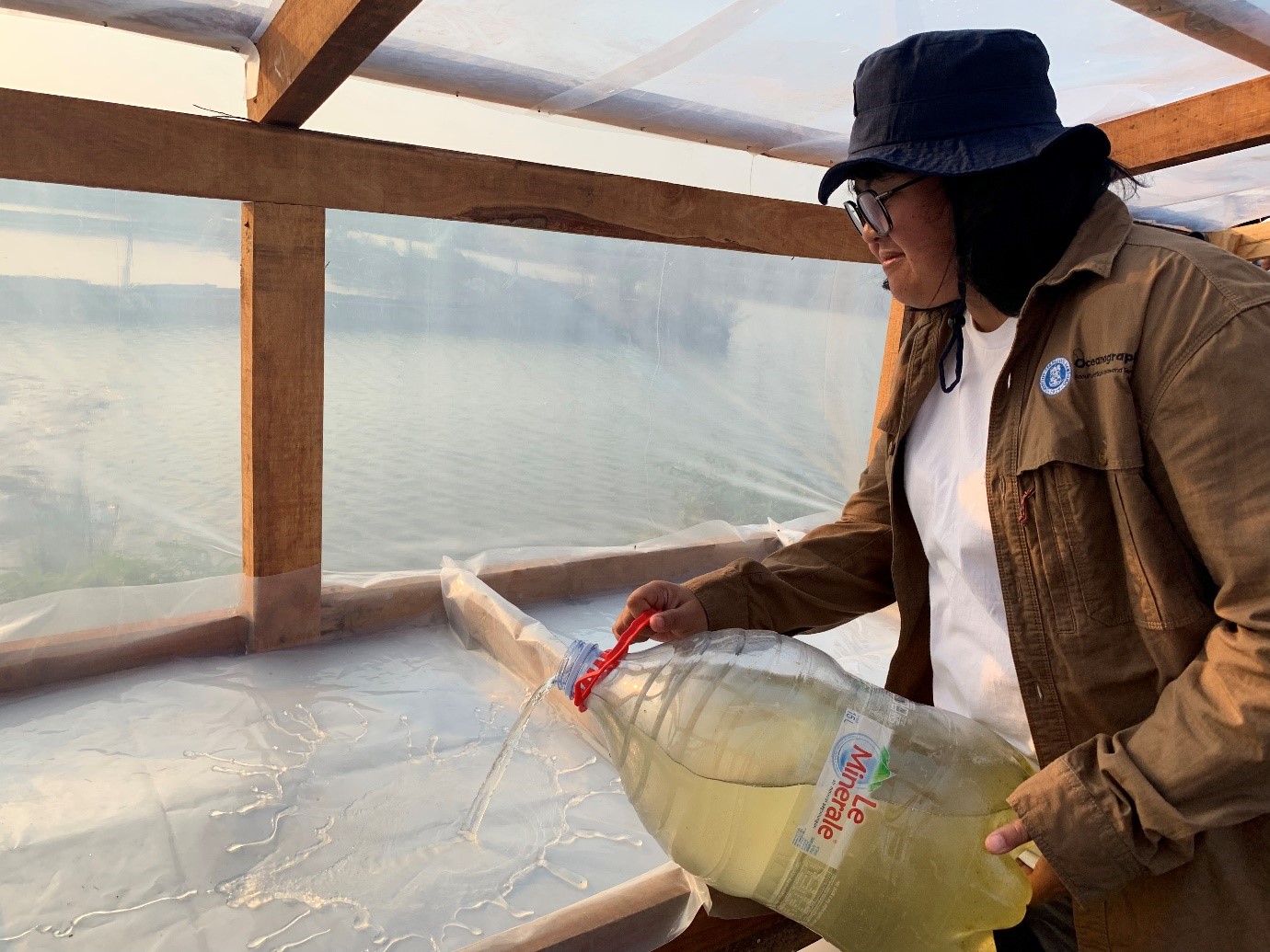
The integrated appropriate technology unit at a salt pond owned by the Jeneponto Regency Government in Pallengu Urban Village consists of an evaporation labyrinth and a tunnel salt house.
The PMKI team constructed the appropriate technology unit by rehabilitating an inactive salt pond owned by the Jeneponto Regency Government in Balobboro, Pallengu Urban Village. Construction began on September 4, 2026, with assistance from the Jeneponto Regency Fisheries and Marine Affairs Office and the local urban village administration.
The approximately 11 脳 15-meter unit consists of an evaporation labyrinth and a transparent tunnel-shaped salt house. The structure protects the crystallization process from rainfall while allowing sunlight to enter and support evaporation.
To reduce contamination from the pond floor, the team installed non-woven geotextile and high-density polyethylene (HDPE) geomembrane materials in the production area.
The unit is also equipped with an Arduino-based Baum茅 degree sensor to monitor brine concentration. This technology helps salt farmers determine when concentrated brine has reached the appropriate level to be transferred to the crystallization ponds.
Water Quality Survey to Support Raw Water Management

The 51探花 team measures water quality using a Water Quality Profiler from a boat in the waters of Bangkala on Tuesday (September 15, 2026).
The 51探花 team conducted water quality surveys in Tamparangkeke Bay and Garassikang Bay on Tuesday (September 15, 2026), using a Rinko JFE Advantech Water Quality Profiler.
Measurements were taken at 10 observation stations, consisting of four stations in each bay and two inlet stations located inside and outside the salt pond area.
The measured parameters included temperature, salinity, density, pH, dissolved oxygen, chlorophyll-a, and turbidity.
The survey data will be used to evaluate the suitability of raw water sources and develop a spatial suitability map for salt pond locations in the Bangkala area. However, a final assessment of site suitability will require further analysis of the collected data.
Improving Salt Quality Through Training

Salt farmers practice salt purification using concentrated brine during the first training session in Pallengu Urban Village.
The PMKI team conducted salt quality improvement training at the Pallengu Urban Village Office on Thursday (September 17, 2026).
The first session was attended by 10 salt farmers and staff members from the Jeneponto Regency Fisheries Office. The 51探花 and Undip teams introduced a crude salt purification technique using concentrated brine, known as brine washing, to reduce impurities, including calcium and magnesium.
Participants also practiced grinding and filtering salt crystals and learned about fortification using potassium iodate (KIO鈧�) at a concentration of 30 parts per million (ppm), in accordance with the Indonesian National Standard (SNI) for consumption salt.
Through these processing stages, the sodium chloride (NaCl) purity level is targeted to reach 98鈥�99 percent.
Purified Salt for Seaweed Post-Harvest Processing

Participants attend a training session on the use of salt for seaweed post-harvest processing and processed fishery products.
The second training session was attended by 10 seaweed farmers and staff members from the Jeneponto Regency Fisheries Office.
Prof. Dr. Kustiariyah Tarman from IPB University introduced the use of salt produced through the appropriate technology system for washing and soaking seaweed to help extend its shelf life and reduce undesirable odors.
Through this approach, salt has the potential to be used as a supporting material in fishery and seaweed processing, creating opportunities to increase added value for coastal communities.
Support from the Local Government
The PMKI 2026 program received support from the Jeneponto Regency Government. On Monday (September 14, 2026), the 51探花 team held a meeting at the Jeneponto Regent's Office with Regional Secretary Dr. Aspa Muji, S.STP., M.Si.; Head of the Regional Development Planning Agency (Bappeda) Dr. H. Alfian Afandy Syam, S.T., M.T., Ph.D.; and Head of the Fisheries and Marine Affairs Office Abd. Rajab Gaus, S.Pi., M.Si.

The 51探花 community service team meets with representatives of the Jeneponto Regency Government on Monday (September 14, 2026).
The main training event was attended by Jeneponto Regent H. Paris Yasir, S.E., M.M.; the Head of the Fisheries and Marine Affairs Office; Bangkala District Head Uud Panca, S.Sos., M.M.; Pallengu Urban Village Head Fadli, S.S.; and members of the local community.
In his remarks, the Regent stated that Bangkala has long been known as a salt-producing area, but production activities frequently come to a halt during the rainy season. According to him, the technologies introduced through the PMKI program could help salt farmers overcome these challenges.
"The Jeneponto Regency Government welcomes this collaboration, as the application of appropriate technology is expected to help salt farmers improve the productivity and quality of community-produced salt. We hope that the technologies developed will go beyond the training stage, be implemented sustainably, and provide lasting benefits to the community," said H. Paris Yasir.

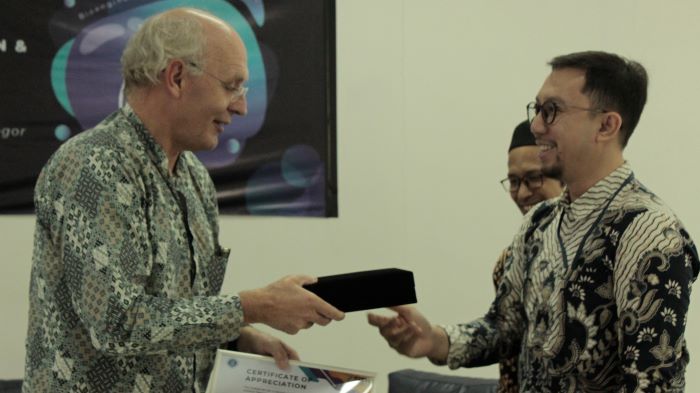
A symbolic handover of the sensor to the Regent of Jeneponto during the main PMKI 2026 training event.
Dr. Lamona expressed her hope that the appropriate technology unit handed over to the community would be managed and utilized sustainably.
"This unit now belongs to the community. We hope that salt farmers in Pallengu will manage it properly so that it can serve as an example for other salt farmers in Jeneponto," she said.
The appropriate technology unit is expected to serve as a model for applying practical technologies to improve community salt production in Jeneponto while contributing to the economic development of coastal communities.