Balancing Motherhood and Research, Noerma Juli Azhari Named 51探花's Best Doctoral Graduate for Her Catalyst Research on Sustainable Energy
By Zahira Rahma, S.Ds. - Magister Desain
Editor M. Naufal Hafizh, S.S.

Noerma Juli Azhari.
BANDUNG, itb.ac.id 鈥� Noerma Juli Azhari, a graduate of the Doctoral Program in Chemical Engineering at Institut Teknologi Bandung (51探花), received the Best Graduate and Best Research Publication awards at 51探花's August 2026 graduation ceremony. Her academic journey has focused on the development of materials and catalysts, particularly technologies that convert materials into valuable compounds with the potential to support more sustainable energy solutions.
Her research was motivated by concerns over carbon emissions and the growing need for environmentally friendly technologies. Through a catalysis-based approach, Noerma investigated material conversion processes to produce valuable compounds, including aromatic compounds such as benzene, toluene, and xylene. These technological developments are expected to benefit industry, advance energy technologies, and contribute to society by promoting more sustainable processes.
Noerma's achievements reflect 51探花's contribution to doctoral education and research, particularly in advancing scientific knowledge relevant to environmental challenges and industrial needs.
Behind her academic accomplishments lies a long journey as a researcher, from learning how to conduct research and write scientific publications to completing her doctoral studies while fulfilling her responsibilities as a mother.
Her academic journey began in the Chemistry Study Program at Universitas Brawijaya. After completing her bachelor's degree, she pursued a master's degree in Chemical Engineering at 51探花 before continuing her doctoral studies in the same field. Her transition from Chemistry to Chemical Engineering broadened her perspective on developing materials and catalysts, which she subsequently applied in her doctoral research.
From Chemistry to Chemical Engineering: Finding Her Path Through Research
Noerma's interest in research began during her undergraduate studies through her participation in the Student Creativity Program (PKM). The program introduced her to various stages of scientific research, from identifying research problems to preparing scientific papers.
Her experience deepened when she pursued her master's degree at 51探花. During this period, Noerma began writing scientific articles for publication in international journals. She acknowledged learning extensively from her academic supervisors, particularly about scientific writing, the publication process, and selecting journals relevant to her research field.
Before beginning her doctoral studies, Noerma had also worked as a research assistant and collaborated on several research projects. These experiences helped her develop a deeper understanding of experimental procedures and scientific publication.
"That program was what sparked my interest in research," she recalled.
Upon entering the doctoral program, Noerma decided to continue her research in Chemical Engineering by building on her foundational knowledge of chemistry. Her work focused on the development and application of materials and catalysts in conversion processes.
One of the central issues addressed in her research was carbon emissions and the need to develop sustainable energy technologies. She investigated the use of catalysts in conversion processes to produce valuable compounds, including benzene, toluene, and xylene.
For Noerma, research goes beyond successful experiments or the ability to produce specific compounds. She views it as a process of advancing knowledge and technology that can ultimately deliver broader benefits to society and the environment.
Achieving the Best Research Publication Award Through Persistence and Repeated Experimentation
Noerma's Best Research Publication award was the culmination of a lengthy process requiring perseverance, continuous evaluation, and adjustments to her research strategies.

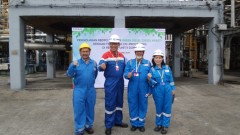
Noerma conducting research at 51探花's Chemical Engineering laboratory during her doctoral studies. (Courtesy of Noerma Juli Azhari)
To overcome the limitations she encountered, Noerma made various adjustments to her research strategies. She tested different approaches, evaluated their effectiveness, and refined them based on experimental results.
According to Noerma, unexpected research outcomes do not necessarily mean that the entire process has failed. Every experiment can still generate new knowledge that serves as a foundation for determining the next steps.
"The important thing is to remain confident and optimistic as we move forward. We improvise, explore alternative approaches, and maintain the belief that our efforts will eventually produce results. This is an essential mindset for researchers," she explained.
This principle helped her maintain consistency throughout her doctoral studies. She understood that research often requires repeated experimentation to identify appropriate approaches and produce scientifically sound findings.
Beyond her persistence in conducting experiments, her success in publishing research findings was also supported by her experience working with academic supervisors and fellow researchers.
Guidance from her supervisors helped her strengthen her scientific writing skills, evaluate research findings, and better understand the publication process in international journals.
Through these experiences, Noerma came to view scientific publication not merely as the final outcome of research but as an integral part of knowledge development. The process encompasses formulating research questions, conducting experiments, evaluating results, and presenting findings in scientific publications that other researchers can use and build upon.
Navigating Research, Pregnancy, and Motherhood
In addition to academic and technical challenges, Noerma pursued her doctoral studies while fulfilling her responsibilities as a mother.
One of her most memorable experiences was continuing her research during pregnancy. Because her laboratory activities involved chemical substances, she had to consider potential exposure risks and make adjustments to her experimental work.
During this period, support from her academic environment played an important role in enabling her research to continue. Her supervisors provided assistance, including involving undergraduate and master's students in laboratory work when Noerma needed to limit her activities.
She also received invaluable support from her family, particularly her husband and parents, who accompanied her throughout her doctoral journey.

Noerma with her parents, husband, and child at her graduation ceremony. (Courtesy of Noerma Juli Azhari)
Despite the challenges, motherhood became one of her greatest sources of motivation to complete her studies.
Noerma recalled moments when she questioned whether she would be able to finish her doctoral degree while managing both family responsibilities and research commitments.
"I'm a mother. I couldn't possibly tell my child, 'I failed to complete my PhD because you were born,' could I?" she said.
This realization encouraged her to persevere. She wanted to demonstrate to her child that family responsibilities and academic aspirations could be pursued through determination, support, and the ability to adapt to changing circumstances.
In addition to her family's encouragement, the scholarship she received from the Indonesia Endowment Fund for Education (LPDP) further strengthened her commitment. She felt a responsibility to complete the education and research made possible through the scholarship funding.
"The second thing is setting priorities, because the scholarship is a significant responsibility. The third is always communicating our needs and concerns," she explained.
According to Noerma, successfully completing doctoral studies requires support from various parties. Effective communication with supervisors, the ability to establish priorities, and family support are essential to maintaining research progress amid changing personal circumstances.
Her experience highlights the importance of a supportive academic environment that enables students to continue their education and research, particularly when they face family responsibilities or circumstances requiring adjustments to their academic activities.
Continuing Research to Advance Sustainable Energy Technologies
After completing her doctoral degree, Noerma remains committed to contributing to the field of catalysis, particularly by developing technologies that support more sustainable energy solutions.
She is currently continuing her academic career as a postdoctoral researcher in Chemical Engineering at the Center for Catalysis Engineering (CCE).
Through her ongoing research, Noerma hopes to further advance knowledge and catalysis technologies that could contribute to clean energy development and efforts to address environmental challenges.
For her, the success of technological development should not be measured solely by the ability to create new materials, products, or processes, but also by their relevance in addressing society's needs.
She also believes that younger generations have tremendous opportunities to contribute through education and research. Access to education can empower more people to develop knowledge, create technologies, and find solutions to various challenges.
Throughout her academic journey, Noerma has maintained a strong sense of optimism and a willingness to keep learning, even when research does not immediately yield the expected results.
"When conducting research, we cannot always see the path ahead. What matters is that we remain optimistic and keep trying. As long as we believe in what we are doing, we can move forward, improvise, and find alternative ways to achieve our goals," she advised.